
If someone asks me whether they should build custom functionality or stick with native HubSpot features, my answer almost always starts with "it depends" because it does. But I'm not leaving you hanging there.
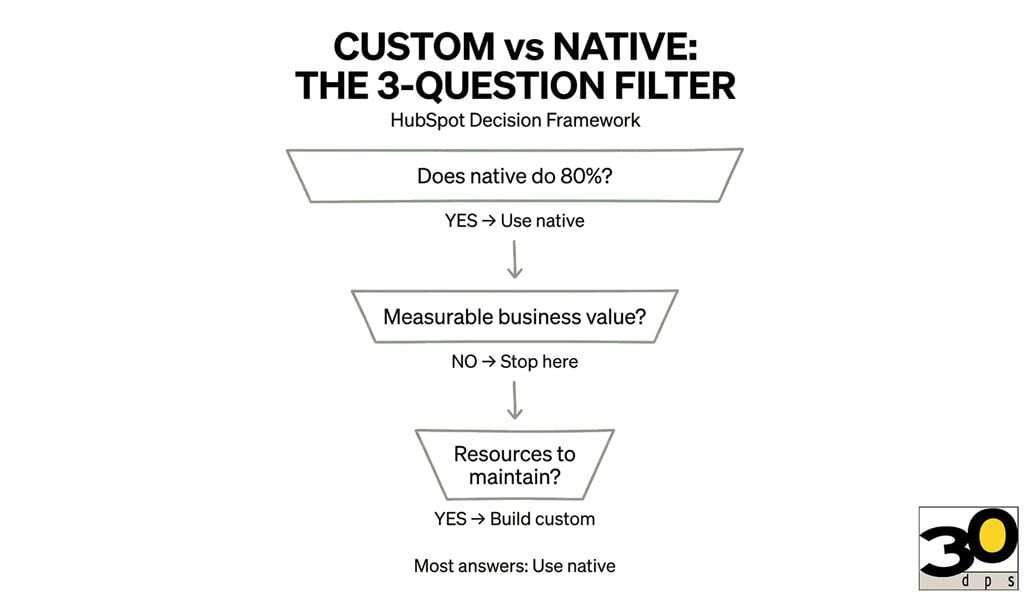
After 35 years building digital solutions and over a decade as a HubSpot partner, I've developed a simple decision tree. Three questions that cut through the noise and make the choice clear.
Question 1: Does Native Do 80% of What You Need?
Start here. Always.
HubSpot's native features are powerful. They're built by a team that obsesses over user experience, they're maintained automatically, and they integrate seamlessly with the rest of your stack.
If native gets you 80% of the way there, use native.
I've watched too many teams burn budget building custom solutions for problems HubSpot already solved. They wanted a specific workflow trigger that existed three menus deep. They needed reporting that was available in a different dashboard.
The 80% rule matters because:
- Native features update automatically when HubSpot improves them
- Your team can find documentation and community support easily
- Future hires already know how to use the tools
- You avoid technical debt from custom code maintenance
That missing 20%? Often it's a nice-to-have, not a must-have. Question whether you're solving a real business problem or just scratching a preference itch.
Question 2: Will This Custom Build Create Measurable Business Value?
Now we're getting serious.
If native doesn't cut it, you need to justify the investment. Custom development costs real money upfront and ongoing maintenance dollars forever.
Calculate the return.
I ask clients to quantify the impact:
- Will this save your team X hours per week? What's that worth annually?
- Will this increase conversion rates by Y%? What's that revenue impact?
- Will this reduce errors that cost Z dollars to fix?
- Will this enable a new service line or revenue stream?
If you can't attach numbers to the outcome, you're not ready to build custom.
I worked with a manufacturing client who needed custom product configuration logic. Native HubSpot couldn't handle their complex pricing rules and off-the-shelf e-commerce solutions didn't fit.
That math worked. We built it. ROI within the first 12 months.
A client wants custom dashboard styling because they don't like HubSpot's color scheme. No business impact. No measurable value. We recommend against building it.
Question 3: Are the Resources Available to Maintain It Long-Term?
This question kills more custom projects than the first two combined.
Building custom functionality is the easy part. Maintaining it for years is where teams get burned.
Custom code requires ongoing attention:
- HubSpot updates their API and you need to adjust your integration
- Your business process changes and the tool needs updating
- A team member leaves and nobody knows how the custom code works
- Security vulnerabilities emerge and need patching
Before you commit to custom development, answer honestly:
Do you have technical resources in-house or a trusted partner relationship? If it's a partner, how long have they been around? Can you budget for maintenance annually? Will someone own this long-term?
I've seen brilliant custom solutions become abandoned orphans because nobody planned for ongoing care. The code still runs but nobody can modify it. The original developer is long gone. The documentation is sparse.
That's a liability, not an asset.
It's good to have confidence that the developer will be around if/when you need them. For example, a team that has been around for 35 years would be a good thing!
Putting the Decision Tree to Work
Here's how I use these three questions in real conversations:
Scenario 1: Client wants custom email template builder
Question 1: Native email builder does 90% of what they need. Use native. Decision made.
Scenario 2: Client needs integration with proprietary manufacturing system
Question 1: Native can't do this. Moving on.
Question 2: Integration will eliminate double data entry, reduce errors by 75%, and save 20 hours weekly. Clear ROI. Green light.
Question 3: Client has internal dev team and annual maintenance budget. Build it.
Scenario 3: Client wants custom deal stage automation logic
Question 1: Native workflows handle 70% of requirements. Close, but not quite there.
Question 2: Custom logic would save maybe 2 hours monthly. Weak ROI. Red flag.
Question 3: No internal resources. Would need ongoing partner support. Stop here. Use native and adjust the process instead.
The Real Answer to "Should I Build Custom?"
Most of the time, the answer is no.
Not because custom development is bad. It's because native features are good enough and the total cost of custom ownership is higher than people expect.
When the answer is yes, these three questions give you confidence. You know native won't work. You've quantified the business value. You've planned for long-term maintenance.
That's when custom development becomes a strategic investment instead of an expensive experiment.
We've been building digital solutions since before HubSpot existed. The tools have changed but the decision framework hasn't. Start with what's already built. Customize only when the business case is clear. Plan for the long game. And be sure you have confidence in your partner long-term, if you outsource.
That's how you make smart technology decisions that serve your business for years, not months.