
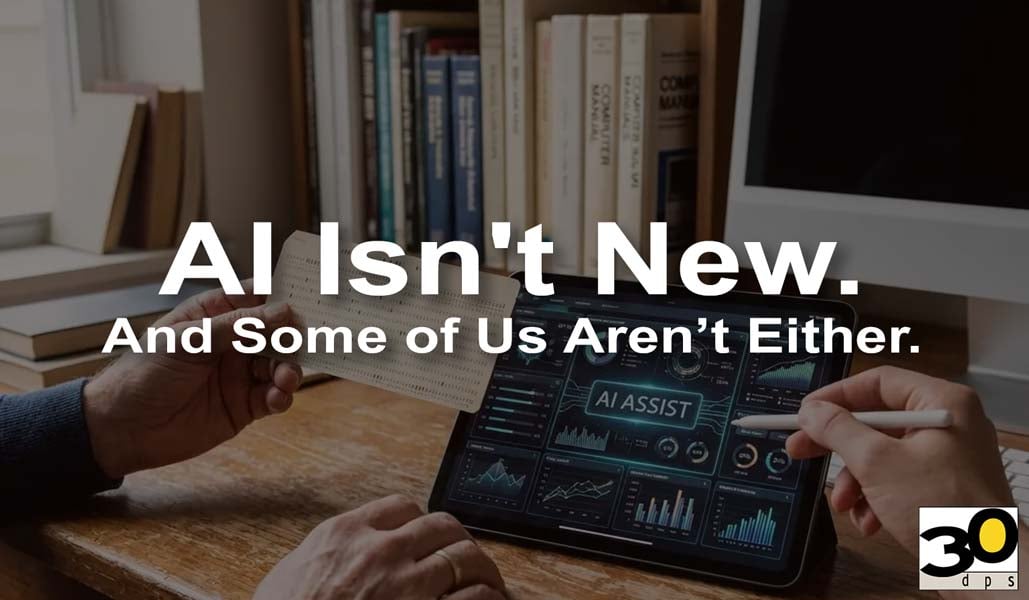
I was standing in the checkout line at Sam's Club a few months ago when a young guy—probably early 20s—asked if I'd consider using their app to skip the line.
I'd been meaning to download it for over a year. Just hadn't gotten around to it.
"Sure," I said.
What happened next was telling.
The young man all but took my iPhone from me so HE could install and configure the app. I kept explaining that I could do it myself. After repeated attempts to reclaim my phone, I finally let him finish.
Then he started explaining bar codes to me.
Bar codes.
I explained to him that I was programming around bar codes when his parents were his age—working for a grocery chain that was one of the first to employ the technology. Years later at FedEx, we lit the world on fire with handheld trackers that used bar codes. I further explained that I was the “techie” in the family.
He literally laughed out loud in disbelief saying, "Really?"
I went on to explain that I'd been in computing for 45 years and currently ran a digital marketing agency specializing in AI.
The look on his face was priceless.
The Pattern Everyone's Missing
Like so many his age, he’s technically savvy because he has been using his phone (and games) since he was born. But most his age have never really experienced a major technological shift. Thus, AI is undoubtedly their first really big new thing.
And because it's their first, they think every big thing feels this revolutionary.
But I've watched this movie before. QuickTime video playing natively on a Mac. Multimedia CD-ROMs. The birth of the web. Email becoming ubiquitous. Marketing automation. CRM systems.
Every single one felt magical at first.
Every single one built on what came before.
Ten years ago, we were working with a client who had a proprietary system for managing SMB growth. We developed online tools to replace his spreadsheet-based approach. Eventually, we helped him realize what he really needed was an intelligent system—a dashboard that could assess, diagnose, and prescribe solutions based on company data.
What we were proposing was an artificial intelligence engine.
We even called it that.
The project never got funded, but the concept was sound. The technology would have been different from what we have today—rote by comparison—but the foundation was identical: data preparation and thoughtful query formulation.
Sound familiar?
That's what we're doing with AI prompts today.
When "New" Technology Isn't Actually New
AI's mathematical foundations were established in 1943. The term "artificial intelligence" was coined at the 1956 Dartmouth Conference—nearly 70 years ago.
Many of today's business leaders have lived through most of AI's developmental history. They just didn't recognize it as "AI" at the time.
When I look at HubSpot's AI tools today, I don't see revolution. I see refinement.
Our clients' CRM data was often a mess—inaccurate, obsolete, incomplete. They knew it, but couldn't wrap their heads around the time and expense to fix it.
Their original chatbot was nice, but mechanical. We had to constantly anticipate every possible need without driving visitors crazy.
We had to look for outside resources to provide lead lists, and they were often flawed and expensive.
HubSpot's AI is solving problems that have plagued CRM and marketing automation for years. That's not revolutionary. That's refinement.
The "new" AI features are solving old problems: messy CRM data, mechanical chatbots, expensive lead lists.
The Real Barrier Isn't Age—It's Packaging
Some business leaders tell me they don't understand AI.
But when I dig deeper, the real barrier isn't comprehension. It's packaging.
AI has been packaged as this scary new thing. And yes, it does seem "magical" compared to working with a spreadsheet or database. The conversational nature feels different.
But strip away the packaging, and you're looking at something these leaders have been doing for decades.
Data preparation. Query formulation. Results analysis. Iteration.
The resistance often stems from three things:
Cost. AI credits can run away with a budget quickly.
Inertia. "We've always done it this way."
Bandwidth. Taking on something new when your schedule is already full.
None of these are about age. None of these are about capability.
And here's what finally breaks through the resistance: competitive pressure.
When leaders see that their competitors who beat them to AI are winning, adoption accelerates.
What Younger Professionals Need to Understand
That Sam's Club moment taught me something important about how younger professionals view experience.
Looks can be deceiving, and the technology they spend all day on was ultimately based on technology created 50-75 years ago by gray-haired “old folks.” They literally often can’t conceive that someone like me is living and breathing AI.
Here's what I wish I could tell every young professional in tech and marketing:
Persona identification isn't just a marketing activity. And persona is largely not related to age.
Why would you view your staff or management with thinking that age determines ability?
Baby boomers predict the most aggressive AI adoption outlook of all generational groups. When surveyed about AI adoption over the next five years, boomers predicted 14 hours per week in time savings compared to Gen Z's 10 hours.
80% of boomers believe generative AI will create new roles.
They're not fearful. They're ambitious.
And here's the hidden advantage: experienced leaders have done this before.
I remember the day I saw my first QuickTime video playing on a tiny black and white Macintosh screen. Seeing video play natively on a computer was magical. It opened the door wide for the kinds of productions we could only dream about.
But I'd been eagerly awaiting it. As a technologist, I just KNEW it would have to happen soon. We were already doing things with animation, but video was the needed next big thing.
We NEEDED it, so the complexity never entered my mind.
That's the pattern younger professionals haven't learned yet: anticipation comes from understanding the trajectory of technology.
The Advantage of Having Been Here Before
I've navigated 30dps through a half-dozen major business shifts over 35 years.
Educational technology consulting. Instructional technology. Multimedia CD-ROM production. Internet solutions. Full-service marketing. HubSpot specialization.
Each transition felt significant at the time. Each required learning new tools, new approaches, new ways of thinking.
But here's what I learned that younger professionals haven't experienced yet:
Technology doubles in power, but the underlying principles remain constant.
Until recent years, AI's computational power doubled roughly every 20 months. Now it's racing ahead, doubling every six months.
That acceleration means even experienced tech professionals are experiencing "first really big new thing" pace.
But the underlying principle of incremental innovation building on existing foundations remains unchanged.
When you've lived through the internet boom and bust, 9/11's devastation of our industry, the shift from CD-ROMs to web-based solutions, the rise of marketing automation, and now AI—you develop pattern recognition.
You learn to separate hype from value.
You learn to ask: Is this a solution looking for a problem, or does it solve a real commercial need?
You learn that the "revolutionary" tools are usually evolutionary steps.
How to Reframe AI for Reluctant Leaders
If you're a younger professional concerned that your management is too old to embrace AI, try this:
Reposition AI as an approach rather than a technology.
Frame it as a powerful business practice that allows employees to be more efficient, salespeople to be more targeted, content to be more customer-focused, and service to be more effective.
When I evaluate whether a "new" technology is worth the investment, I use some instinct and some research. I'm always wary of a solution looking for a problem.
If it feels like one of those, we may play with it, but we don't waste time on it.
If it feels like there's real potential for commercial application, we take a closer look.
That's the framework experienced leaders use. And it's the same framework that works for AI adoption.
What Experienced Leaders Need to Do
If you're a leader who's been through multiple technology transitions, you have an advantage.
But you need to use it.
Encourage experimentation and reward successful experiments. Let your team know that YOU fully support smart implementation of AI. Ask them to look at ways of making their job more rewarding, more efficient, more accurate, more expansive.
Show them how AI can make the company more profitable because they're doing their job better.
And here's the critical part: help them recognize that you're not learning something entirely new.
You're applying decades of experience with databases, spreadsheets, CRM systems, and marketing automation to a more sophisticated tool set.
That 2015 AI engine project that never got funded? The client walked back in my door recently with new intellectual property. We're helping him solidify his product and find funding through AI—his own AI avatar, AI-generated content, AI-generated video, AI-generated presentations, and HubSpot with all its AI features.
He has a working AI-powered prototype now.
The need was always there. The technology finally caught up.
The Intergenerational Opportunity
Here's what both younger and older professionals need to understand:
The best AI adoption happens when experience meets enthusiasm.
Younger professionals bring fresh perspectives, comfort with new interfaces, and willingness to experiment.
Experienced leaders bring pattern recognition, business judgment, and the ability to separate hype from value.
When you combine those strengths, adoption accelerates.
McKinsey's 2025 research reveals that AI high performers are three times more likely to have senior leaders who demonstrate ownership and actively champion AI initiatives.
The challenge isn't that leaders are too old to understand AI. It's that some leaders aren't moving fast enough—regardless of age.
Only 1% of companies believe they're at AI maturity despite widespread investment.
The competitive pressure is real. From roughly one-in-five companies using AI in 2017, adoption grew to roughly three-in-four companies by 2024.
Companies not adopting AI are in the shrinking minority.
What This Means for Your Business
If you're a business leader reading this, here's what you need to know:
You already understand the foundations of AI. You've been working with data, queries, and iterative improvement for years. The interface is different. The power is greater. But the principles are the same.
Your experience is an advantage, not a liability. You've seen technology hype cycles before. You know how to evaluate commercial viability. You understand how to implement change without disrupting operations.
The resistance you feel isn't about capability. It's about packaging, cost concerns, and bandwidth. Those are solvable problems.
Your competitors are moving. 78% of organizations used AI in 2024. The question isn't whether to adopt AI. It's how quickly you can do it intelligently.
And if you're a younger professional, remember this:
Gray hair doesn't mean tech-averse. It often means pattern recognition, business judgment, and hard-won wisdom about what actually works.
The leaders who programmed bar code systems, built the internet, and developed multimedia technologies aren't too old to understand AI.
They're perfectly positioned to champion it. You just need to figure out how to create prompts (a.k.a. questions and conversations) that trigger their experience in ways that will advance your company’s accomplishments to new heights. If you do, you’ll be her/his new super star.